
Why sleep trackers make tired people feel worse
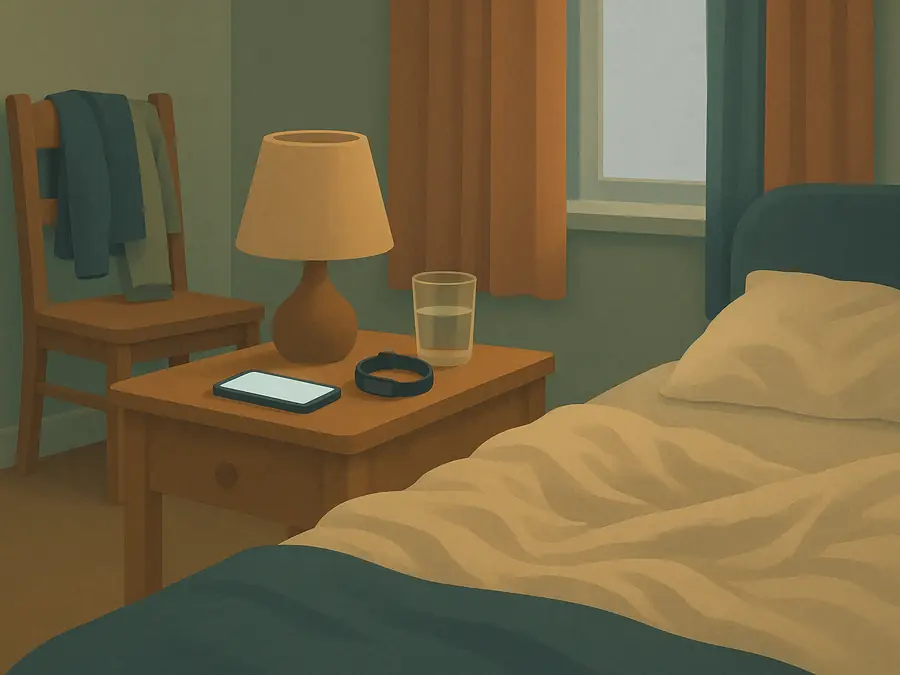
They turn a bad night into a grade, and the grade follows you into the morning. You already knew you were tired.
If you’ve worn one, you know the feeling. You wake up, and before your feet are on the floor you’ve checked. Sixty-one. Forty minutes awake. And now you know something you didn’t know a second ago, which is that today is going to be a bad one.
Except you did know. You could feel it. The number didn’t tell you anything your body hadn’t already said. What it did was make it official.
They’re measuring the wrong thing
A tracker is good at hours. It’s good at stages, and variance, and how long you were awake at four in the morning. Those are real measurements and we’re not going to pretend otherwise.
But think about what’s actually gone missing. It isn’t hours. It’s patience with the people at home. It’s saying yes to something on a Friday. It’s the version of you that used to turn up on an ordinary Tuesday.
None of those appear on a wrist. So you end up with a very precise answer to a question you weren’t asking.
A score punishes the week you’ve already had
Many of them add a streak on top. Then a catch-up. Then a nudge, because you’ve slipped.
If you’ve been sleeping badly for months rather than days, that’s a machine telling you you’re failing, every morning, in numbers you can’t argue with. Sleep clinicians have a name for where this ends up for some people. They call it orthosomnia, and it’s what happens when chasing a better score starts making the sleep itself worse.
The people who stick with tracking are often the ones who like being measured. If that’s you, you probably don’t need us. The people we built this for have been measured plenty.
And a score has to go somewhere
A score has to be worked out somewhere, and compared with something. That’s what a score is. So your nights go to a company’s computers, and they stay there.
We don’t have a score, so we don’t need your nights. What you write in your log stays on your phone. It isn’t on our servers, and there’s nowhere on them for it to go. That’s a stronger thing than a promise. We also keep your account details and the structured information needed to run your plan, and our privacy policy lists all of it.
Send us feedback and that does reach us, because you sent it.
What we do instead
We start with the reason. Not the hours, but what the tiredness is costing you, because that’s the part that makes anyone want to do something about it.
Then we build a plan small enough to survive the worst night of your week. No score. No streak. Nothing to get back to zero from, because there’s no zero. Miss a night and you pick up where you left off, and we won’t mention it.
We start with sleep because it’s the cheapest place to find out whether this holds for you at all.
And you don’t need a wearable. If you’ve already got one, keep it. Just don’t let it be the thing that decides what sort of day you’re allowed to have.
Then it keeps going. One question each morning, in your own words. What you say changes what gets offered next, so the plan moves as your week does. That’s the part a score can’t do.
A better way to work out what to change next.
Three minutes. No card. No wearable needed.
This is one device, and it is one case of a wider thing. Why what worked for someone else doesn’t always work for you sets out the research behind it.
Which one sounds like you?
The people who matter get what’s left of you.
You keep saying no to things you’d have said yes to.
You get through the days. You just haven’t been in them.